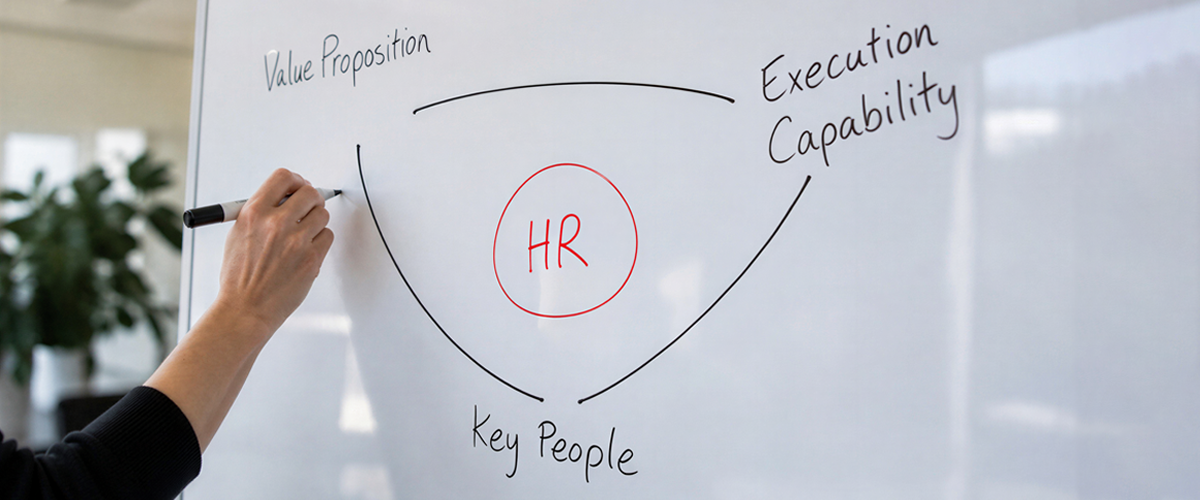
Making human resources a true strategic driver is a challenge. Day-to-day operational demands often leave little room for HR to step back and contribute fully to business objectives. Yet, by adopting this perspective and asking the right questions, HR can play a genuinely strategic role within the organization.
We propose three complementary levers to help achieve this:
- Understand the business strategy and value proposition.
- Build the organizational capabilities needed to execute the business strategy.
- Engage key people around organizational success.
Lever 1: Align With the Value Proposition
Understanding the business context in order to act more effectively may seem obvious for HR. But do we truly take the time to step back, examine our organization from a broader perspective, and most importantly, ask the right questions?
In our recent article “ Setting the Stage for 2027: 6 Questions to Align Your HR Priorities with Your Business Strategy”, we proposed a series of questions designed to help organizations understand their strategy, identify priorities, anticipate future needs, uncover barriers and risks, and ultimately determine the HR priorities that will have the greatest impact.
The key question to ask is: What are our value-creation drivers? In other words, what makes customers choose us, and what differentiates us from the competition?
The answer will help identify the organizational capabilities required to deliver that value proposition.
Be at the center of this conversation!
Balancing Today’s Realities While Preparing for Tomorrow
We encourage you to use the H1, H2, and H3 Horizons framework to balance priorities between the present, the near future, and the longer-term future. The goal is to structure the organization to meet today’s needs while developing the capabilities it will require tomorrow.
| Horizon | Business Questions | HR’s Role |
|---|---|---|
| H1 | How do we deliver results today? | Ensure the organization has the right people, structure, and processes to execute the strategy. |
| H2 | What will we need to support future growth? | Develop future organizational capabilities. |
| H3 | What kind of organization must we become to achieve our vision? | Anticipate future talent, leadership, and transformations. |
Lever 2: Unlock Execution Capability
Once the direction is clear, the organization must be able to execute it. Even the most promising HR initiatives will generate limited results if the organization lacks the expertise, leadership, or stability required to carry them through.
We therefore recommend four essential steps and supporting tools to help build an optimal organizational structure.
Assess Your Organizational Structure
A SWOT analysis (strengths, weaknesses, opportunities, threats) helps assess the current structure by highlighting its strengths and weaknesses, as well as factors that may hinder progress or create risks to achieving business priorities.
| Strengths | Weaknesses |
|---|---|
| Quels sont les éléments de votre structure actuelle qui vous permettent de bien fonctionner? | Qu’est-ce qui vous freine dans la structure organisationnelle actuelle? |
| Opportunities | Threats |
| What opportunities could influence your current structure? | What threats could affect your current structure? |
The objective is straightforward: determine what should be maintained, strengthened, or redesigned to help teams collaborate more effectively, make decisions more efficiently, and focus their energy on activities that truly create value.
Trust us, this exercise works. Leaders are generally familiar with the framework and quickly engage in the discussion.
Define Success Criteria for Your Future Structure
Before redesigning a structure, it is helpful to clarify what it must enable. Speed of execution, teamwork, clarity of accountability and authority, the number of management layers, decision-making effectiveness, and innovation are all potential criteria.
The choice will naturally depend on the context. A rapidly growing company may prioritize execution speed and role clarity, while an organization undergoing transformation may focus on strengthening collaboration and innovation.
The important thing is to define what the new structure must enable before deciding what it should look like.
Map Your Core Business Process
To identify the expertise, skills, and tools required, mapping the Core Business Process helps visualize the key stages through which the organization creates and delivers value.
For each stage, identify:
- Key activities.
- Required skills and expertise.
- Necessary tools and technologies.
This exercise helps identify the functions, positions, expertise, and tools that are essential to delivering your value proposition. It also prompts two fundamental questions: Is your current structure the right one? What capabilities are missing to deliver your value proposition?
Clarify Roles and Responsibilities Using RASCI
Even a well-designed structure loses effectiveness when responsibilities are unclear. The RASCI matrix helps define who is Responsible, who is Accountable, who provides Support, who must be Consulted, and who must be Informed for any given activity.
The exercise involves listing the team’s primary responsibilities and assigning a specific role to each person. It strengthens accountability, accelerates decision-making, and enables managers and leaders to focus on higher-value activities.
As discussed in more detail in our previous article “CEO: End Organizational Ambiguity with RASCI”, RASCI is a simple and effective tool for removing organizational uncertainty.
Lever 3: Engage Key People Around Organizational Success
Once the right people are in the right roles, organizations must also engage those who contribute most significantly to their success.
Identify Key People and Key Roles
Not all key people are important for the same reasons. Some consistently deliver reliable performance. Others demonstrate strong growth potential. Some stand out because of exceptional performance, while others contribute through culture, relationships, and organizational knowledge.
The nature of roles must also be considered. Some are strategic because they are directly tied to long-term strategy and performance. Others are critical because a departure or an unfilled absence would quickly affect operations. Some individuals possess rare or highly specialized expertise that is difficult to replace in the labour market.
To identify them, organizations must look beyond job titles, hierarchy levels, and tenure, and understand the actual influence of each role on business priorities. To support this process, we encourage you to develop employee personas specific to your organization and identify their expectations, needs, and aspirations.
Ask yourself: Who plays a key role in delivering our customer value proposition?
Tailor Engagement Mechanisms to Key People
Once key people and key roles have been identified, the organization can determine the most appropriate engagement mechanisms, whether focused on short-term engagement, long-term retention, succession development, or other objectives. The key is to select the approaches that best align with employee profiles and business goals.
Before considering a long-term incentive plan such as share ownership, two foundations must already be in place: a competitive Total Rewards program and a strong employee experience.
Engaging key people is not based solely on financial incentives. It may also include:
- An accelerated development plan.
- Involvement in strategic discussions.
- Career growth opportunities.
- Participation in special projects.
- Recognition programs.
- Knowledge-sharing and knowledge-transfer opportunities.
- Structured succession planning.
Key people do not all have the same needs or level of interest. Engagement mechanisms can be adapted based on the different categories of individuals identified. The goal is to create an environment where these individuals can fully realize their potential and contribute meaningfully to organizational success.
Moving From Vision to Action
Making HR a strategic driver means strengthening the organization’s capacity to execute its business strategy.
To achieve this, ask yourself three questions:
- Does our leadership team truly understand and align around our customer value proposition?
- Do we have the structure, processes, and expertise required to deliver it?
- Have we identified and engaged the people who will have the greatest impact on our success?
By helping the organization answer these three questions, HR does more than support the strategy. It contributes directly to its execution and to the organization’s sustainable performance.
Need support strengthening your execution capability and engaging key people around your business priorities?
Partager